The Caregiver's Complete Guide to Total Knee Replacement Recovery at Home in Bhavnagar
Find post-op pain relief for your parent with this TKR recovery guide. Learn how a home visit physiotherapist in Bhavnagar ensures safe rehabilitation over 3 to 8 weeks.
When a parent undergoes a Total Knee Replacement (TKR) at a premier local facility like HCG Hospitals, Shubham Orthopaedic, or VishwaKarma Hospital, the surgical procedure is merely the first phase of their journey toward pain-free mobility. For the adult children coordinating this care in Bhavnagar, the reality of managing the post-operative recovery at home can feel overwhelming. The responsibility of ensuring medications are taken, the home is safe, and the knee regains its full function is a significant undertaking.
The most critical element determining the success of a knee replacement is the immediate, structured physical therapy that follows hospital discharge. The artificial joint itself is perfect, but the surrounding muscles, tendons, and ligaments have been traumatized and require meticulous retraining. Without proper guidance, patients risk developing severe scar tissue, leading to permanent stiffness and a failed surgical outcome.
For families balancing professional careers and household duties, transporting a parent in immense pain to a physiotherapy clinic in dense traffic across Kaliyabid or Kalanala is logistically impossible during the early weeks. This is why hiring a home visit physiotherapist in Bhavnagar has become the clinical standard for TKR recovery. This comprehensive guide outlines the exact timeline, the essential therapeutic exercises, and the necessary lifestyle modifications required to ensure your parent’s safe rehabilitation right here in Bhavnagar.
The Clinical Necessity of Post-Operative Physiotherapy
A common misconception among patients is that rest equates to healing. Following a knee replacement, excessive rest is actually detrimental. Physical therapy begins within hours of the surgery while the patient is still in the hospital ward, focusing on basic circulation to prevent life-threatening complications such as deep vein thrombosis (blood clots).
Once your parent returns home, the physiological goals of physiotherapy at home are precise:
- Edema Management: Controlling the profound swelling and inflammation that naturally occurs around the joint.
- Restoring Range of Motion (ROM): Pushing the knee to achieve full extension (zero degrees of straightness) and deep flexion (bending past 90 degrees) before scar tissue solidifies.
- Muscular Hypertrophy and Neuromuscular Control: Rebuilding the atrophied quadriceps, hamstrings, and gluteal muscles to provide stability to the new artificial joint, allowing the patient to eventually walk without assistive devices.
The Home Recovery Timeline: What Caregivers Must Expect
Recovery is a marathon, not a sprint. Depending on the patient’s age, pre-surgical fitness, and overall health, the active rehabilitation period typically spans 3 to 8 weeks. The trajectory is rarely linear, and understanding the distinct phases of rehabilitation will help you set realistic expectations and alleviate frustration for both you and your parent.
Phase 1: The Acute Recovery Phase (Approximately Week 1)
The earliest days at home are the most challenging. Your parent will be utilizing a walker, and pain management is the absolute priority. During this phase, the focus is entirely on basic mobility, wound healing, and achieving preliminary range of motion.
The management of pain and swelling relies heavily on the “3 E’s” protocol:
- Exercise: Gentle, highly repetitive movements to stimulate blood flow.
- Elevation: The leg must be elevated above the level of the heart when resting. Crucial Caregiver Tip: Always place the supporting pillow under the calf or the ankle. Never place a pillow directly behind the operative knee, as this promotes flexion contractures and permanently limits the ability to straighten the leg.
- Ice (Cryotherapy) vs. Heat Warning: Applying cold packs for 15 to 20 minutes every few hours significantly reduces tissue inflammation. Crucial Warning for Indian Households: Avoid using hot water bags or heat packs during the acute swelling phase. While Indian households traditionally default to applying heat for any joint pain, doing so on a fresh, swollen knee after a TKR will worsen inflammation, increase pain, and delay recovery. Only ice should be used to manage acute post-op swelling.
Struggling with your parent’s acute post-op pain? Contact Dr. Hetvi Goyani for an immediate home assessment in Bhavnagar. Call or WhatsApp +91 7990860522 to schedule a consultation.
Phase 2: The Subacute Strengthening Phase (Weeks 2 to 4, Varying by Patient)
As the surgical incision heals and the acute pain subsides, therapy shifts toward functional independence. The physiotherapist will guide your parent through transitioning from a walker to a walking stick or cane at a pace suited to their progress.
This is the critical window for mastering stair climbing. The universally accepted clinical mnemonic for negotiating stairs safely is: “Good goes up to heaven, bad goes down to earth.” Your parent must be instructed to step up with their unoperated, stronger leg first, and to step down leading with the operated, weaker leg. The milestone for this phase is navigating the interior of the home independently.
Phase 3: The Advanced Rehabilitation Phase (Weeks 4 to 8, Varying by Patient)
In the final phase, the focus expands to endurance, advanced balance, and preparing the patient to return to community activities. Therapy sessions will incorporate complex, multi-joint movements. Depending on the surgeon’s clearance and the patient’s individual progress, patients may begin utilizing stationary cycling to enhance synovial fluid circulation within the joint, and many are cleared to resume routine activities and take extended walks in local parks or community centers.
Foundational Physiotherapy at Home Exercises
Under the strict supervision of a certified physiotherapist, your parent will perform a highly structured protocol of exercises. It is vital that these are performed with correct biomechanics to avoid stressing the implant.
- Ankle Pumps: The patient briskly points and flexes their feet, simulating a pumping action. This simple movement is critical for venous return, actively preventing deep vein thrombosis.
- Quadriceps Sets (Quad Sets): While lying supine (flat on the back), the patient actively contracts the anterior thigh muscle, attempting to press the back of the knee flat against the bed. This isometric contraction, held for five seconds, is foundational for regaining leg control.
- Heel Slides: Remaining supine, the patient slowly slides the heel of the operative leg toward their glutes, bending the knee as deeply as pain permits, before slowly sliding it back to full extension. This is the primary exercise for regaining joint flexion.
- Straight Leg Raises: Once neuromuscular control is established, the patient tightens the quadriceps and lifts the entirely straight leg approximately twelve inches off the bed surface, significantly challenging the hip flexors and thigh musculature.
Cultural and Lifestyle Modifications for Indian Homes
Recovering from orthopedic surgery in Bhavnagar necessitates specific environmental adaptations that differ from Western recovery models. Caregivers must proactively modify the home environment prior to the patient’s discharge.
- Sanitation and Toilet Facilities: The utilization of a Western-style commode is absolutely mandatory. Indian-style toilets require profound, weight-bearing knee flexion (deep squatting), a biomechanical action strictly prohibited during the first three to six months of recovery to prevent implant dislocation or failure. Families lacking a Western toilet must procure a raised commode chair immediately.
- Seating Mechanics: Post-operative patients must avoid sitting cross-legged (Palaathi or Jameen par baithna) on the floor or on beds. Sitting on low surfaces places immense sheer stress on the new joint during the transition to standing. Patients should exclusively utilize firm, elevated chairs equipped with sturdy armrests to assist in the sit-to-stand motion.
- Nutritional Support: Bone integration and tissue repair demand substantial metabolic fuel. Caregivers should ensure the provision of a high-protein diet incorporating elements like dal, paneer, eggs, and soya. Furthermore, integrating natural anti-inflammatory components such as turmeric (haldi) and ginger can naturally assist in managing systemic swelling. Dietary sodium must be monitored, as excessive salt exacerbates fluid retention around the operative site.
The Advantage of a Home Visit Physiotherapist in Bhavnagar
Navigating the complexities of a parent’s surgical recovery should not be a solitary burden. Dr. Hetvi Goyani, armed with rigorous B.P.T. credentialing and specialized Kinesio Taping certification, delivers hospital-grade orthopedic rehabilitation directly to your residence.
Serving neighborhoods comprehensively across Bhavnagar, from Vidhyanagar to Jewels Circle, Dr. Goyani’s home-visit model provides unparalleled advantages:
- Uncompromised Comfort: The patient executes their rehabilitation in the familiarity of their own living space, entirely eliminating the physical agony and logistical nightmare of vehicular transport.
- Bespoke Clinical Attention: Therapy sessions are strictly one-on-one, allowing for minute biomechanical corrections and immediate adaptation of the protocol based on daily pain levels and progress.
- Comprehensive Caregiver Education: Dr. Goyani prioritizes training the family unit, demonstrating precisely how to assist with transfers, recognize warning signs of complications, and maintain a hazard-free home environment.
Do not compromise your parent’s mobility through delayed or inadequate rehabilitation. Immediate, professional physiotherapy is the definitive key to unlocking a pain-free, independent future.
To find a reliable physiotherapist near me and secure a comprehensive home visit physio in Bhavnagar, contact Dr. Hetvi Goyani today.
Direct Call or WhatsApp Consultation: +91 7990860522
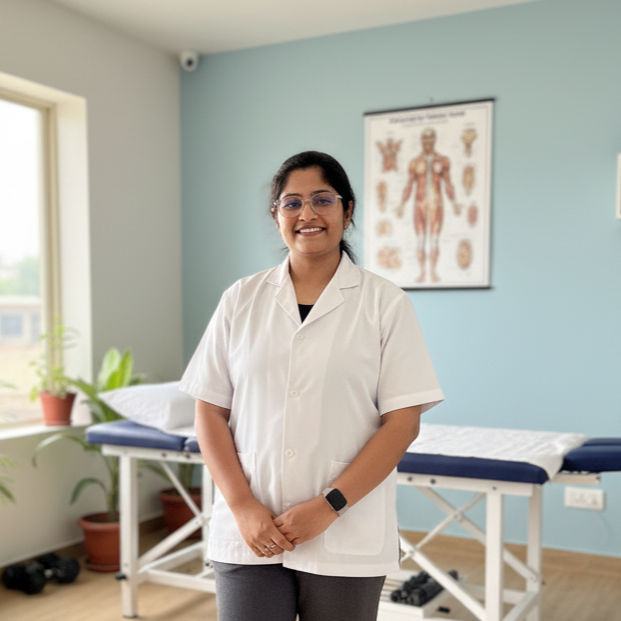
Dr. Hetvi Goyani (Physiotherapist)
Dr. Hetvi Goyani is a skilled and caring physiotherapist with a B.P.T. degree and certified expertise in Kinesio Taping, specializing in home and hospital visits across Bhavnagar, Gujarat. She is certified in Kinesio Taping and dedicated to helping patients recover mobility, manage acute and chronic pain, and rebuild physical wellness.